Home
What is KMHRP?
Where is KMHRP? Historical Photos
Park Habitats Bird Photos, List, Where to
Butterflies Essays About the Park
Park Abuse Wilmington Drain
Helping Harbor Park
Where is KMHRP? Historical Photos
Park Habitats Bird Photos, List, Where to
Butterflies Essays About the Park
Park Abuse Wilmington Drain
Helping Harbor Park
Dragonflies & Damselflies

Blue-eyed Darner

Blue Dasher
A PRELIMINARY LIST OF KMHRP ODONATA
Ken Malloy Harbor Regional Park, in the city of Los Angeles contains the largest natural (original) lake in the entire city.
It has been preserved to the degree that it is the "last stand" for extensive freshwater marsh and riparian habitat, in a reasonably natural state, in the L.A. basin. While undoubtedly some species of ODES have disappeared from the site due to pollution and habitat alteration, it appears to still have resonably good ODE diversity to this day.
The following species are those known from KMHRP. The real exploration of the "ODES" (short for the order Odonata, which is Dragonflies and Damselflies) at the site only began in 2002, so, the list is preliminary at best. But, it is a start at least. Hopefully someone will pick up the ball and run! There is next to nothing known about things like what are local flight periods, etc. of the particular species.
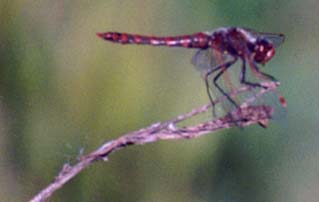
Variegated Meadowhawk
Here's the list
(last revision to this page, July 27, '03)
Class - Insecta
Order - Odonata - Dragonflies and Damselflies
DRAGONFLIES - suborder Anisoptera
1) Green Darner - Anax junius - common
2) Giant Darner - Anax walsinghami - seen 7&8 "03
3) Blue-eyed Darner - Aeshna multicolor - common
4) Variegated Meadowhawk - Sympetrum corruptum - common
5) Western Pondhawk - Erythemis collocata - sighting 5 "03
6) Blue Dasher - Pachydiplax longipennis - common
7) Mexican Amberwing - Perithemis intensa - old sight record
8) Flame Skimmer - Libellula saturata - common
9) Black Saddlebags - Tramea lacerata - always a few
10) Red Saddlebags - Tramea onusta - always a few
11) Wandering Glider - Pantala flavescens - common
12) Spot-winged Glider - Pantala hymenaea - a few

Spot-winged Glider
In 2003, ten of the dragon species listed above, were seen in 2.5 hours on May 20, and ten of these species were seen again on July 19 in about four hours at the park! That's very respectable ODE diversity! Ten species of dragons, findable in a day, at just this one site, right here in the city of Los Angeles! Amazing!

Blue Dasher - young male
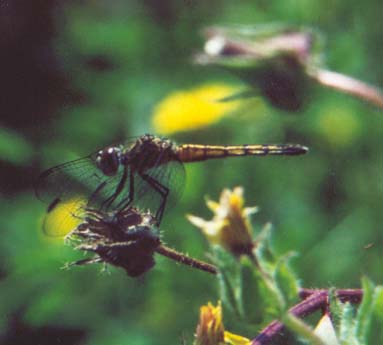
female Blue Dasher
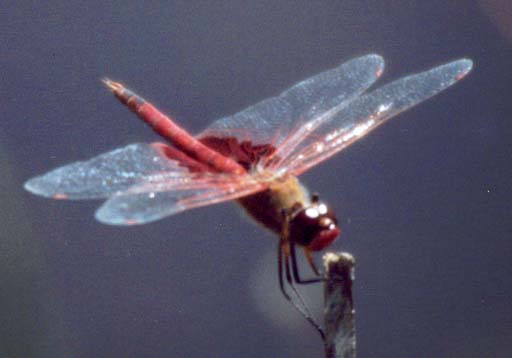
Red Saddlebags
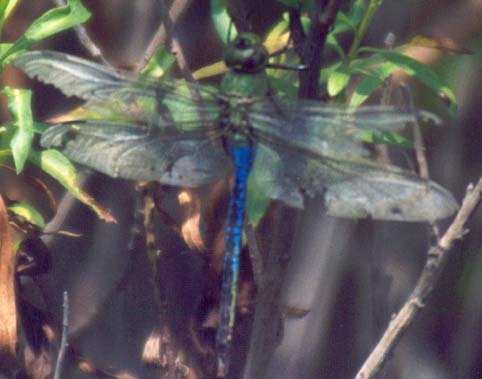
Green Darner - a very old one
Look at those wings!
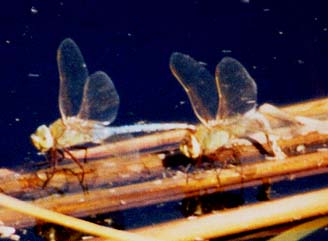
Green Darner - pair ovipositing
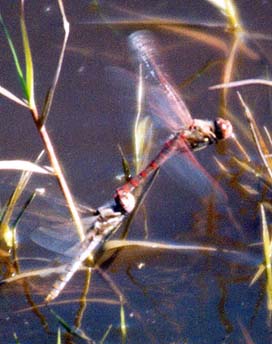
Variegated Meadowhawk - pair ovipositing
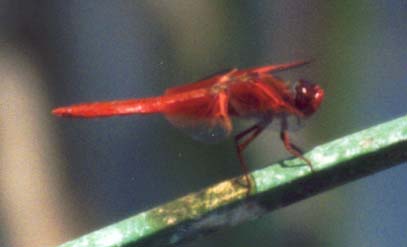
Flame Skimmer - male
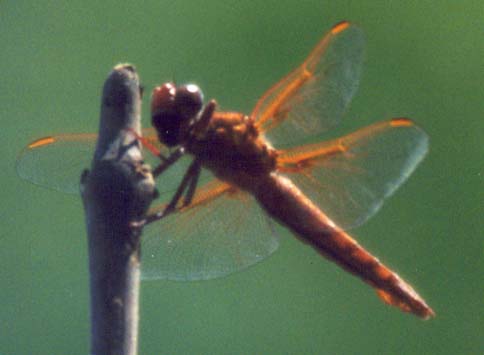
Flame Skimmer - female
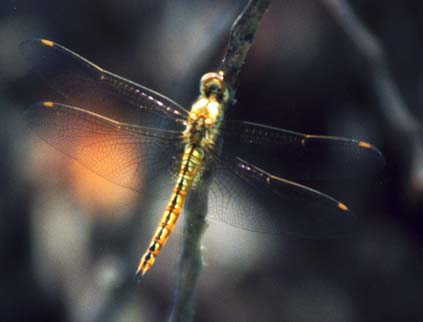
Wandering Glider
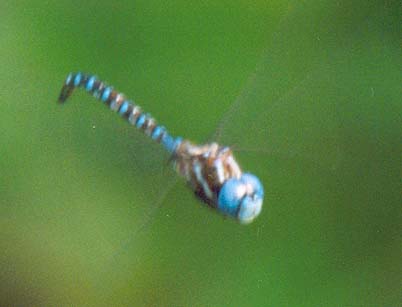
Blue-eyed Darner
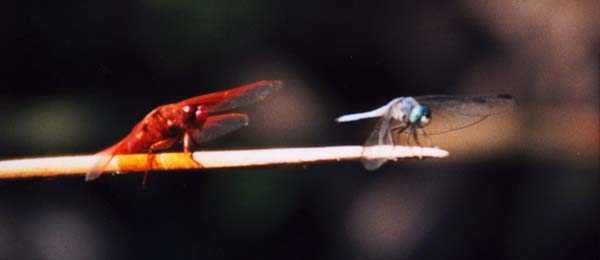
Flame Skimmer and Blue Dasher - EYE CANDY!

Typical Damselfly (a Bluet)
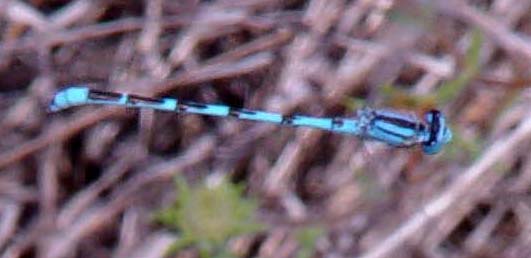
Arroyo Bluet
Photo by Jess Morton
DAMSELFLIES - suborder Zygoptera
List is tentative, since ID is more difficult than larger dragons
Spreadwing sps. - Lestes sps.? (2 types)
type 1: very uniform pruinose blue-green
resembling Common - not supposed to be here.
type 2: emerald green above, beige-straw below
resembling Emerald - not supposed to be here.
P.S.: another "not supposed to be here" Spreadwing is at Madrona Marsh
Bluet sps. - ???? at least four known
1) Tule Bluet - Enallagma carunculatum
confirmed in hand - probably common
2) Northern/Boreal ?? (mostly blue) also common
3) Familiar Bluet - Enallagma civlie
4) Arroyo Bluet - Enallagma praevarum
Forktails - two are confirmed:
Pacific Forktail - Ischnura cervula
Black-fronted Forktail - Ischnura denticollis
Dancers - one positively
Vivid Dancer - Argia vivida
other Dancer sps.? -
(CA or Aztec should be present)
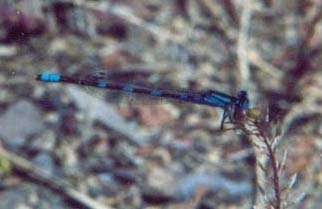
Bluet sps. (Enallagma sps.)


scanned Bluets

Black-fronted Forktail
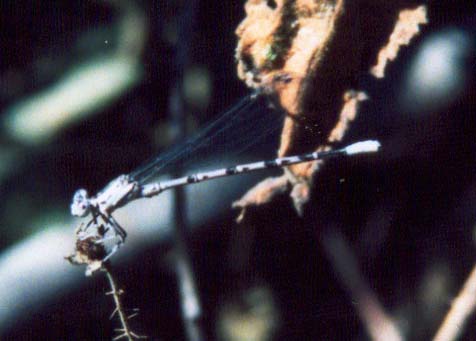

Vivid Dancer - teneral male
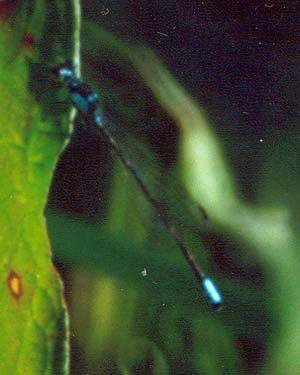

Pacific Forktail + pair in wheel
The brown is a drying tip of a leaf
Eight species at very minimum have been found in the first year of looking, with the most rudimentary skills and knowledge. I would be very surprised if less than TEN species of Damselflies (Zygops) are present at KMHRP.
Here are a couple Madrona Marsh damsels ...

Black-fronted Forktail
Some are very iridescent appearing yellow above

Spreadwing of some type
Their wings aren't ALWAYS spread.
Between Dragons (12 species) and Damsels (8+ species so far) combined, there are 20 ODE species at minimum living at or using the KMHRP currently. Two dozen species are probably occurring!
If you know of Dragon or Damsel records from KMHRP (or Bixby Slough, Harbor Park,) please let me know, so we can continue to build the already impressive list for the site. It would be nice to make a calendar that shows which species are seen which months. No Damsels were detected at the site from mid-Oct. 2002 through early March 2003, indicating an extended period when flying adult Damsels are not to be seen locally.
Other species fluctuate as hatches - or more properly emergences, of flying adults occur. Variegated Meadowhawks are abundant in May and September but scarce in late July and early August - between emergences (?) I think. Some come out early first thing after sunup like Blue Dasher and Blue-eyed Darner, and Flame Skimmers and Saddlebags wait for it to really heat up before showing themselves. What sort of migrations do we get locally? We have much to learn about these amazing beasts!
To learn about or identify Dragons and Damsels ("Odes"), try one of the following references. The first is better for beginners, and covers Damsels & Dragons. The second is national in scope, but only covers Dragons. The third is new and required for the serious.
Common Dragonflies of California -
A Beginners Pocket Guide, by Kathy Biggs,
Azalea Creek Publishing, 2000
The above is an excellent starter guide! Get it first, and when your ID questions go beyond its scope, get the new Manolis book!
Dragonflies through Binoculars by Sidney Dunkle Oxford University Press, 2000 Covers all Dragons of Canada and the U.S.
A new must-have book has just come out, which very thoroughly covers (and is called) "Dragonflies and Damselflies of California," by Tim Manolis, 2003. It is an incredible book. You can order it at the website below.
A great Ode website exists as a companion to the first mentioned book.
Ode website
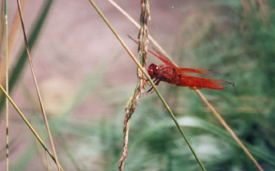
Flame Skimmer
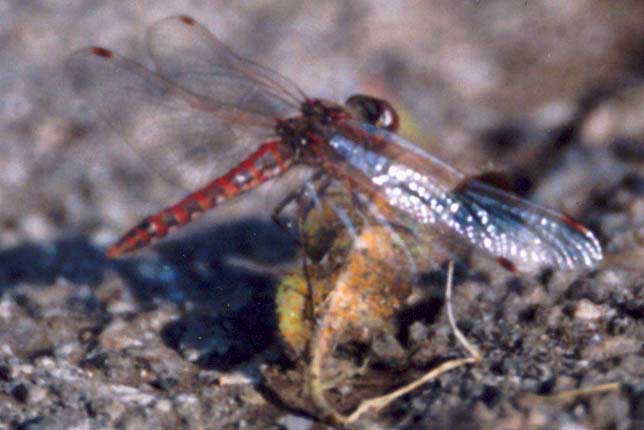
Variegated Meadowhawk
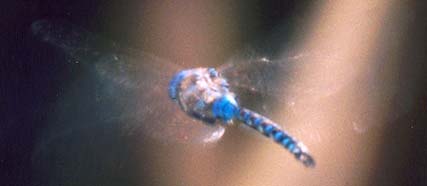
Blue-eyed Darner
the end
Blue-eyed Darner
Blue Dasher
A PRELIMINARY LIST OF KMHRP ODONATA
Ken Malloy Harbor Regional Park, in the city of Los Angeles contains the largest natural (original) lake in the entire city.
It has been preserved to the degree that it is the "last stand" for extensive freshwater marsh and riparian habitat, in a reasonably natural state, in the L.A. basin. While undoubtedly some species of ODES have disappeared from the site due to pollution and habitat alteration, it appears to still have resonably good ODE diversity to this day.
The following species are those known from KMHRP. The real exploration of the "ODES" (short for the order Odonata, which is Dragonflies and Damselflies) at the site only began in 2002, so, the list is preliminary at best. But, it is a start at least. Hopefully someone will pick up the ball and run! There is next to nothing known about things like what are local flight periods, etc. of the particular species.
Variegated Meadowhawk
Here's the list
(last revision to this page, July 27, '03)
Class - Insecta
Order - Odonata - Dragonflies and Damselflies
DRAGONFLIES - suborder Anisoptera
1) Green Darner - Anax junius - common
2) Giant Darner - Anax walsinghami - seen 7&8 "03
3) Blue-eyed Darner - Aeshna multicolor - common
4) Variegated Meadowhawk - Sympetrum corruptum - common
5) Western Pondhawk - Erythemis collocata - sighting 5 "03
6) Blue Dasher - Pachydiplax longipennis - common
7) Mexican Amberwing - Perithemis intensa - old sight record
8) Flame Skimmer - Libellula saturata - common
9) Black Saddlebags - Tramea lacerata - always a few
10) Red Saddlebags - Tramea onusta - always a few
11) Wandering Glider - Pantala flavescens - common
12) Spot-winged Glider - Pantala hymenaea - a few
Spot-winged Glider
In 2003, ten of the dragon species listed above, were seen in 2.5 hours on May 20, and ten of these species were seen again on July 19 in about four hours at the park! That's very respectable ODE diversity! Ten species of dragons, findable in a day, at just this one site, right here in the city of Los Angeles! Amazing!
Blue Dasher - young male
female Blue Dasher
Red Saddlebags
Green Darner - a very old one
Look at those wings!
Green Darner - pair ovipositing
Variegated Meadowhawk - pair ovipositing
Flame Skimmer - male
Flame Skimmer - female
Wandering Glider
Blue-eyed Darner
Flame Skimmer and Blue Dasher - EYE CANDY!
Typical Damselfly (a Bluet)
Arroyo Bluet
Photo by Jess Morton
DAMSELFLIES - suborder Zygoptera
List is tentative, since ID is more difficult than larger dragons
Spreadwing sps. - Lestes sps.? (2 types)
type 1: very uniform pruinose blue-green
resembling Common - not supposed to be here.
type 2: emerald green above, beige-straw below
resembling Emerald - not supposed to be here.
P.S.: another "not supposed to be here" Spreadwing is at Madrona Marsh
Bluet sps. - ???? at least four known
1) Tule Bluet - Enallagma carunculatum
confirmed in hand - probably common
2) Northern/Boreal ?? (mostly blue) also common
3) Familiar Bluet - Enallagma civlie
4) Arroyo Bluet - Enallagma praevarum
Forktails - two are confirmed:
Pacific Forktail - Ischnura cervula
Black-fronted Forktail - Ischnura denticollis
Dancers - one positively
Vivid Dancer - Argia vivida
other Dancer sps.? -
(CA or Aztec should be present)
Bluet sps. (Enallagma sps.)
scanned Bluets
Black-fronted Forktail
Vivid Dancer - teneral male
Pacific Forktail + pair in wheel
The brown is a drying tip of a leaf
Eight species at very minimum have been found in the first year of looking, with the most rudimentary skills and knowledge. I would be very surprised if less than TEN species of Damselflies (Zygops) are present at KMHRP.
Here are a couple Madrona Marsh damsels ...
Black-fronted Forktail
Some are very iridescent appearing yellow above
Spreadwing of some type
Their wings aren't ALWAYS spread.
Between Dragons (12 species) and Damsels (8+ species so far) combined, there are 20 ODE species at minimum living at or using the KMHRP currently. Two dozen species are probably occurring!
If you know of Dragon or Damsel records from KMHRP (or Bixby Slough, Harbor Park,) please let me know, so we can continue to build the already impressive list for the site. It would be nice to make a calendar that shows which species are seen which months. No Damsels were detected at the site from mid-Oct. 2002 through early March 2003, indicating an extended period when flying adult Damsels are not to be seen locally.
Other species fluctuate as hatches - or more properly emergences, of flying adults occur. Variegated Meadowhawks are abundant in May and September but scarce in late July and early August - between emergences (?) I think. Some come out early first thing after sunup like Blue Dasher and Blue-eyed Darner, and Flame Skimmers and Saddlebags wait for it to really heat up before showing themselves. What sort of migrations do we get locally? We have much to learn about these amazing beasts!
To learn about or identify Dragons and Damsels ("Odes"), try one of the following references. The first is better for beginners, and covers Damsels & Dragons. The second is national in scope, but only covers Dragons. The third is new and required for the serious.
Common Dragonflies of California -
A Beginners Pocket Guide, by Kathy Biggs,
Azalea Creek Publishing, 2000
The above is an excellent starter guide! Get it first, and when your ID questions go beyond its scope, get the new Manolis book!
Dragonflies through Binoculars by Sidney Dunkle Oxford University Press, 2000 Covers all Dragons of Canada and the U.S.
A new must-have book has just come out, which very thoroughly covers (and is called) "Dragonflies and Damselflies of California," by Tim Manolis, 2003. It is an incredible book. You can order it at the website below.
A great Ode website exists as a companion to the first mentioned book.
Ode website
Flame Skimmer
Variegated Meadowhawk
Blue-eyed Darner
the end
Home
What is KMHRP?
Where is KMHRP?
Historical Photos
Park Habitats
Bird Photos, List, Where to
Butterflies Essays About the Park
Park Abuse Wilmington Drain
Helping Harbor Park
E-mail
All contents © Mitch Heindel 2005-2015
What is KMHRP?
Where is KMHRP?
Historical Photos
Park Habitats
Bird Photos, List, Where to
Butterflies Essays About the Park
Park Abuse Wilmington Drain
Helping Harbor Park
All contents © Mitch Heindel 2005-2015