Home
Where is KMHRP?
Park Habitats Historical Photos
Bird Photos, List, Where to Butterflies
Dragonflies Essays About the Park
Park Abuse Wilmington Drain
Helping Harbor Park
Park Habitats Historical Photos
Bird Photos, List, Where to Butterflies
Dragonflies Essays About the Park
Park Abuse Wilmington Drain
Helping Harbor Park
What is KMHRP?
So what the heck is this KMHRP anyway?
NOW
KMHRP is Ken Malloy Harbor Regional Park. It is often called Harbor Park, by locals or "old-timers" (like me), its first official name after it became public. It is the third largest park in the city of Los Angeles, but that is the least of its claims to fame.

KMHRP is how much of L.A. used to look!
It lies where Wilmington, San Pedro and Harbor City meet, just a half-mile from the L.A. Harbor. It is bounded by PCH and Anaheim on the north and south; Vermont and the 110 Fwy.,west and east.

KMHRP is Lake Machado
Like many parks it can be a great place for a family outing. There are playgrounds for the kids and picinic tables with grills. There are walking paths around the lake with beautiful scenery. For being in the big city, the distinct feeling of "wide-open spaces," and in some areas natural native habitats representive of those present a hundred, two hundred and more years ago. You can even catch and release some Large-mouth Bass in the 4-6 pound class! For thousands of Angelinos it is the closest most accessible open space with the most diverse recreational opportunities.
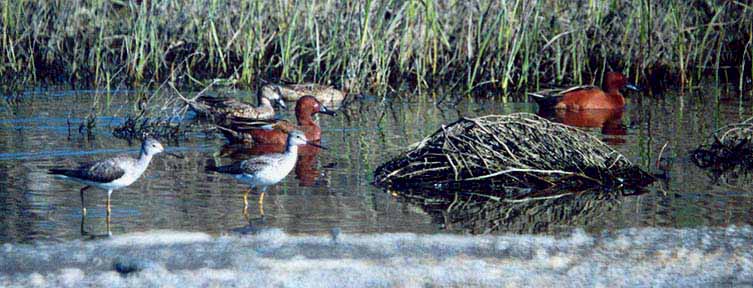
KMHRP is Wetlands with Wildlife
It contains the largest piece of original native riparian forest and freshwater marsh and lake in coastal L.A. County. It has the greatest bird diverstiy (over 330 types known from the site) of any site in the city or county of L.A., of similar size.

KMHRP is a Freshwater Marsh & Lake
At 241 acres it probably contains the greatest bio-diversity of any like sized site in the county, but certainly in the coastal section of the city. (From Sta. Monica to Long Beach). Unfortunately, much of it is disappearing due to habitat degradation.
About a third of its breeding bird species (diversity) have been lost since the records began in the late 1800's (down 33% in the last century). This minute remnant of L.A.'s once common original native habitat is is the biggest piece of this type we have left.
THEN
The Lake is generally considered to have been an "oxbow," or "bend in a river," from the L.A. River's location at some point in the past. It was tidal at some point as well. Many effects are still present, such as beach sand and many "sea shells" in some areas.
Going back to the earliest of known times, it was a center of Native American habitization locally, with several villages around it over the years. Many artifacts have been recovered from the site. That alone should give it all the protection and respect that all such siginificant historical sites enjoy.

KMHRP is Riparian Willow Forest
More recently when the Spaniards invaded from Mexico and enslaved the native americans, it remained at the center of activity, with trading posts (the "Casa de Sangre" at 5-points), etc. around it. The ranchos of some of LA's important early colonizers, Sepulveda, Dominguez, and Machado, sort of met around the lake.
The lake has been renamed officially its name of a hundred years ago honoring his important part in Los Angeles' history: Lake Machado He lived where the golf course sits today. Surely Machado, Dominguez, and Sepulveda had all rested, cooled off, and probably hunted in the "bosque" (woods).
The riparian willow forest around the lake was named Canada de los Palos Verdes in the mid-1600's (!) by Vizcaino! I would like to see what's left of the forest (the north-end
willows along PCH) renamed Bosque Palos Verdes
to honor this part of its heritage.

KMHRP is the Great Outdoors in the Big City
In the mid-1800's the "sweetwater" that was stored at the drum barracks nearby in Wilmington, which was used by ships on long trips asea, was from here! But don't drink the water today!
Early in the last century, it was in the middle of hundreds of oil derricks, and mud was mined at the lake. There was also an airfield at one time, near where the college sits today, which both Earhart and Lindberg flew out of!
The site was known as Bixby Slough for some time when owned by the Bixby family of Long Bch. (a sign on PCH at the Wilmington Drain still calls it such).
There are bird records from the site dating back a hundred years. It has long been known as a fantastic place for birds. It was a top-notch duck hunting place at one time. People even used to water ski on the lake!
MORE RECENTLY
The city of L.A. purchased it in the 1950's, mostly at the urging of the Izzaak Walton League, to preserve it as open space in the big city. A primary focus was an urban fishing place. Of course one must take care of the habitat and environment to have healthy fish to consume.
It was officially developed into a park in the very late 1960's. That was when the lawns and facilities were put in on the west side of the lake along Vermont Avenue. That was all native willows and mulefat, removed for the lawns. It was still very wild and natural, as late as the mid-1960's.

KMHRP is Amazing Butterflies
Unfortunately the ground pollution got so bad the fish became toxic, and the state quit stocking it decades ago. Perhaps one day they will be edible again if we muster the will to clean our environment up.
The cultural and historical values seem to me to be largely overlooked and forgotten. This is a shame because it devalues the incredible history of the site. Remember the fact that at other times in its history there were grizzly bears there, and thousands of years ago, undoubtedly Sabre-tooth Cats!

KMHRP is Waterfowl in Winter
To find out more about the areas amazing history, there are a couple excellent accounts that have been published.
Palos Verdes Peninsula: Time and the Terraced Land, by Augusta Fink, Western Tanager Press, Santa Cruz,CA, reprinted in 1987 is very interesting reading.
So is Don Gales' book: Handbook of Wildflowers, Weeds, Wildlife and Weather of the South Bay and Palos Verdes Peninsula, published by FoldaRoll Company, PVP, CA; 3rd edition, 1988.
Both have some incredible historical accounts and photos... Local bookstores often carry both of them, and they are must reads for locals.

Kids Love KMHRP
NOW
Where else within a half-hour drive, could you take a class of youth and show them what it's like to be in the middle of a forest and marsh, and hundreds of birds, butterflies and dragonflies? Tens of thousands of youth live within a half-hour bus ride of the site. The hundreds who have participated in the PV/SoBay Audubon summer camps there would love to tell you what a great experience it was for them.
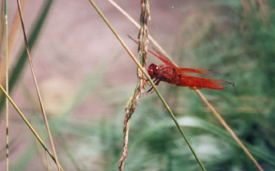
KMHRP is Awesome Dragonflies
The site has been mired in between bureaucracy and neglect that has precluded effective management for decades, operating without a master plan, or the complete cooperation and coordination of all the agencies with jurisdiction.
THE FUTURE
Now under new leadership, it appears to be getting some attention after decades of neglect (the "south side syndrome"). The Great Botulism and Mosquito outbreak of 2002 probably helped along the task force that has been convened that includes all the agencies with jurisdiction, and groups with vested interest, and heads are being put together to solve the parks problems. For the first time in its history, all the vested parties are actually meeting to solve the problems decades of neglect created. There is hope! It is important to remember the people who are having to face the results of neglect, and fix the problems, are not the ones who created them. These are brave people!

KMHRP is Beautiful Sunrises
Most people who see some photos of the habitats there cannot believe it is L.A.. Most of the public does not know such a thing is available to them in the "harbor area." Educating the public about its recreation opportunities, and making it safe for all to go and enjoy them, will hopefully change this in time. It is our hope to do some of that with this website.

KMHRP is a Wildlife Sanctuary
It is a diamond in the rough. A misunderstood, and for decades mis-managed, gem. There is nothing like it in the city or county of Los Angeles. It is precious. It represents the best opportunity the city or county has to save a piece of what once was coastal LA in its near original state. The only such piece left from Santa Monica to Long Beach. Already a world-class birding place, it could be a world-class outdoor education place.
BUT ...
A CAUTION ABOUT VISITING THE PARK:
It would not be fair to not warn you of possible safety concerns before you go exploring the site. It is a very urban park. There has been a population of homeless that for nearly the last decade have taken over the north-end willows along PCH. A woman should not go there by herself. Men are safer in groups as well.
There is a severe health hazard in that the forest floor is their toilet, (not to mention how this pollutes the lake (and harbor) every time it rains). Mud boots are required to try the trails there. Several lone (male) birders have been threatened, so if possible don't go alone. Maybe carry pepper spray; there are often very threatening dogs. Of course a cell phone might be handy. Go there in a group.

This is being cleaned up and out
There is a new ordinance to help enforce camping laws. The north-end willows are closed to entry except from 10 a.m. to 4 p.m.. You can walk the edge any time (where most of the good birds have been seen anyway). In the near future this should eliminate the homeless problem and most safety issues.
The main part of the west side of lake, and all across the dam, the bike path to the east side (and the mitigation site) are all safe due to high public foot traffic levels. All the lower wetland is safe and hassle free too... It's just the north end where extra caution is order of the day.

KMHRP is Green Open Space
If you are careful you should be able enjoy the park without incident. Many of the birds that used to nest in the north-end willows are now gone due to this new constant "people pressure" and disturbance complete with dogs and cats.
April to October mosquito repellant might be a good idea to have on hand, especially if you venture into the woods or marsh. They are worst at sunup and dusk (when some of the best birding is to be had of course), and with WNV surely on its way, better err on the side of caution. Longsleeves are best early and late. Over 30+ years I have never gotten a tick there. All PV horsetrails are loaded with them, and a good reason to keep horses out!
"Virtually" explore the habitats, birds, butterflies, and dragonflies, here at the website, then go see it for yourself at the park! Have fun! And when you're done, please do something to help it.

KMHRP is nature at your doorstep!
So what the heck is this KMHRP anyway?
NOW
KMHRP is Ken Malloy Harbor Regional Park. It is often called Harbor Park, by locals or "old-timers" (like me), its first official name after it became public. It is the third largest park in the city of Los Angeles, but that is the least of its claims to fame.
KMHRP is how much of L.A. used to look!
It lies where Wilmington, San Pedro and Harbor City meet, just a half-mile from the L.A. Harbor. It is bounded by PCH and Anaheim on the north and south; Vermont and the 110 Fwy.,west and east.
KMHRP is Lake Machado
Like many parks it can be a great place for a family outing. There are playgrounds for the kids and picinic tables with grills. There are walking paths around the lake with beautiful scenery. For being in the big city, the distinct feeling of "wide-open spaces," and in some areas natural native habitats representive of those present a hundred, two hundred and more years ago. You can even catch and release some Large-mouth Bass in the 4-6 pound class! For thousands of Angelinos it is the closest most accessible open space with the most diverse recreational opportunities.
KMHRP is Wetlands with Wildlife
It contains the largest piece of original native riparian forest and freshwater marsh and lake in coastal L.A. County. It has the greatest bird diverstiy (over 330 types known from the site) of any site in the city or county of L.A., of similar size.
KMHRP is a Freshwater Marsh & Lake
At 241 acres it probably contains the greatest bio-diversity of any like sized site in the county, but certainly in the coastal section of the city. (From Sta. Monica to Long Beach). Unfortunately, much of it is disappearing due to habitat degradation.
About a third of its breeding bird species (diversity) have been lost since the records began in the late 1800's (down 33% in the last century). This minute remnant of L.A.'s once common original native habitat is is the biggest piece of this type we have left.
THEN
The Lake is generally considered to have been an "oxbow," or "bend in a river," from the L.A. River's location at some point in the past. It was tidal at some point as well. Many effects are still present, such as beach sand and many "sea shells" in some areas.
Going back to the earliest of known times, it was a center of Native American habitization locally, with several villages around it over the years. Many artifacts have been recovered from the site. That alone should give it all the protection and respect that all such siginificant historical sites enjoy.
KMHRP is Riparian Willow Forest
More recently when the Spaniards invaded from Mexico and enslaved the native americans, it remained at the center of activity, with trading posts (the "Casa de Sangre" at 5-points), etc. around it. The ranchos of some of LA's important early colonizers, Sepulveda, Dominguez, and Machado, sort of met around the lake.
The lake has been renamed officially its name of a hundred years ago honoring his important part in Los Angeles' history: Lake Machado He lived where the golf course sits today. Surely Machado, Dominguez, and Sepulveda had all rested, cooled off, and probably hunted in the "bosque" (woods).
The riparian willow forest around the lake was named Canada de los Palos Verdes in the mid-1600's (!) by Vizcaino! I would like to see what's left of the forest (the north-end
willows along PCH) renamed Bosque Palos Verdes
to honor this part of its heritage.
KMHRP is the Great Outdoors in the Big City
In the mid-1800's the "sweetwater" that was stored at the drum barracks nearby in Wilmington, which was used by ships on long trips asea, was from here! But don't drink the water today!
Early in the last century, it was in the middle of hundreds of oil derricks, and mud was mined at the lake. There was also an airfield at one time, near where the college sits today, which both Earhart and Lindberg flew out of!
The site was known as Bixby Slough for some time when owned by the Bixby family of Long Bch. (a sign on PCH at the Wilmington Drain still calls it such).
There are bird records from the site dating back a hundred years. It has long been known as a fantastic place for birds. It was a top-notch duck hunting place at one time. People even used to water ski on the lake!
MORE RECENTLY
The city of L.A. purchased it in the 1950's, mostly at the urging of the Izzaak Walton League, to preserve it as open space in the big city. A primary focus was an urban fishing place. Of course one must take care of the habitat and environment to have healthy fish to consume.
It was officially developed into a park in the very late 1960's. That was when the lawns and facilities were put in on the west side of the lake along Vermont Avenue. That was all native willows and mulefat, removed for the lawns. It was still very wild and natural, as late as the mid-1960's.
KMHRP is Amazing Butterflies
Unfortunately the ground pollution got so bad the fish became toxic, and the state quit stocking it decades ago. Perhaps one day they will be edible again if we muster the will to clean our environment up.
The cultural and historical values seem to me to be largely overlooked and forgotten. This is a shame because it devalues the incredible history of the site. Remember the fact that at other times in its history there were grizzly bears there, and thousands of years ago, undoubtedly Sabre-tooth Cats!
KMHRP is Waterfowl in Winter
To find out more about the areas amazing history, there are a couple excellent accounts that have been published.
Palos Verdes Peninsula: Time and the Terraced Land, by Augusta Fink, Western Tanager Press, Santa Cruz,CA, reprinted in 1987 is very interesting reading.
So is Don Gales' book: Handbook of Wildflowers, Weeds, Wildlife and Weather of the South Bay and Palos Verdes Peninsula, published by FoldaRoll Company, PVP, CA; 3rd edition, 1988.
Both have some incredible historical accounts and photos... Local bookstores often carry both of them, and they are must reads for locals.
Kids Love KMHRP
NOW
Where else within a half-hour drive, could you take a class of youth and show them what it's like to be in the middle of a forest and marsh, and hundreds of birds, butterflies and dragonflies? Tens of thousands of youth live within a half-hour bus ride of the site. The hundreds who have participated in the PV/SoBay Audubon summer camps there would love to tell you what a great experience it was for them.
KMHRP is Awesome Dragonflies
The site has been mired in between bureaucracy and neglect that has precluded effective management for decades, operating without a master plan, or the complete cooperation and coordination of all the agencies with jurisdiction.
THE FUTURE
Now under new leadership, it appears to be getting some attention after decades of neglect (the "south side syndrome"). The Great Botulism and Mosquito outbreak of 2002 probably helped along the task force that has been convened that includes all the agencies with jurisdiction, and groups with vested interest, and heads are being put together to solve the parks problems. For the first time in its history, all the vested parties are actually meeting to solve the problems decades of neglect created. There is hope! It is important to remember the people who are having to face the results of neglect, and fix the problems, are not the ones who created them. These are brave people!
KMHRP is Beautiful Sunrises
Most people who see some photos of the habitats there cannot believe it is L.A.. Most of the public does not know such a thing is available to them in the "harbor area." Educating the public about its recreation opportunities, and making it safe for all to go and enjoy them, will hopefully change this in time. It is our hope to do some of that with this website.
KMHRP is a Wildlife Sanctuary
It is a diamond in the rough. A misunderstood, and for decades mis-managed, gem. There is nothing like it in the city or county of Los Angeles. It is precious. It represents the best opportunity the city or county has to save a piece of what once was coastal LA in its near original state. The only such piece left from Santa Monica to Long Beach. Already a world-class birding place, it could be a world-class outdoor education place.
BUT ...
A CAUTION ABOUT VISITING THE PARK:
It would not be fair to not warn you of possible safety concerns before you go exploring the site. It is a very urban park. There has been a population of homeless that for nearly the last decade have taken over the north-end willows along PCH. A woman should not go there by herself. Men are safer in groups as well.
There is a severe health hazard in that the forest floor is their toilet, (not to mention how this pollutes the lake (and harbor) every time it rains). Mud boots are required to try the trails there. Several lone (male) birders have been threatened, so if possible don't go alone. Maybe carry pepper spray; there are often very threatening dogs. Of course a cell phone might be handy. Go there in a group.
This is being cleaned up and out
There is a new ordinance to help enforce camping laws. The north-end willows are closed to entry except from 10 a.m. to 4 p.m.. You can walk the edge any time (where most of the good birds have been seen anyway). In the near future this should eliminate the homeless problem and most safety issues.
The main part of the west side of lake, and all across the dam, the bike path to the east side (and the mitigation site) are all safe due to high public foot traffic levels. All the lower wetland is safe and hassle free too... It's just the north end where extra caution is order of the day.
KMHRP is Green Open Space
If you are careful you should be able enjoy the park without incident. Many of the birds that used to nest in the north-end willows are now gone due to this new constant "people pressure" and disturbance complete with dogs and cats.
April to October mosquito repellant might be a good idea to have on hand, especially if you venture into the woods or marsh. They are worst at sunup and dusk (when some of the best birding is to be had of course), and with WNV surely on its way, better err on the side of caution. Longsleeves are best early and late. Over 30+ years I have never gotten a tick there. All PV horsetrails are loaded with them, and a good reason to keep horses out!
"Virtually" explore the habitats, birds, butterflies, and dragonflies, here at the website, then go see it for yourself at the park! Have fun! And when you're done, please do something to help it.
KMHRP is nature at your doorstep!
Home
Where is KMHRP?
Park Habitats
Historical Photos
Bird Photos, List, Where to
Butterflies
Dragonflies
Essays About the Park
Park Abuse
Wilmington Drain
Helping Harbor Park
E-mail
All contents © Mitch Heindel 2005-2015
Where is KMHRP?
Park Habitats
Historical Photos
Bird Photos, List, Where to
Butterflies
Dragonflies
Essays About the Park
Park Abuse
Wilmington Drain
Helping Harbor Park
All contents © Mitch Heindel 2005-2015